
 Lizaveta Herman
The short answer
For buyers with cash or cheap finance, the window is opening. Many small landlords say they will sell, while rents still rise 3.8% a year. On our £220,000 house a 10% discount lifts the return on cash from 1.1% to 2.9%. At a 6% mortgage rate the deal still leans on that discount.
Who is selling, and who is buying
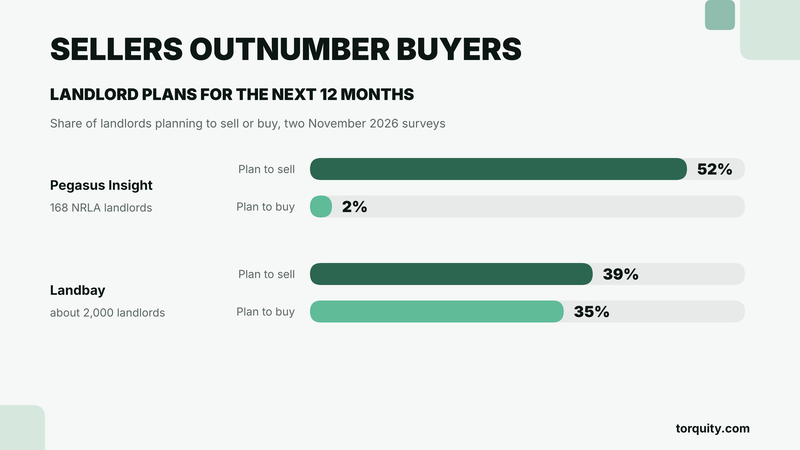
A Pegasus Insight poll of 168 National Residential Landlords Association members ran after the Autumn Budget. 52% planned to sell within 12 months and only 2% planned to buy more (Mortgage Solutions, November 2026). 73% expected the tax changes to push rents up.
A larger Landbay survey of about 2,000 landlords gives a softer picture. 39% expect to sell at least one property in the next year. 35% plan to buy (Landlord Today, November 2026).
The buyers look different from the sellers. Limited companies made 52% of mortgaged buy-to-let purchases in the first half of 2026, according to Paragon Bank (Mortgage Solutions).
The market signals
- Rents: UK private rents rose 3.8% in the year to October 2026, to an average of £1,411 a month (ONS).
- Prices: UK house prices rose 1.2% in the year to September 2026. London fell 3.5% and the North East rose 4.6%.
- Distress: UK Finance counted 690 buy-to-let repossessions in Q3 2026, up 10% on the quarter and down 23% on the year. Arrears covered 0.43% of buy-to-let mortgages (Landlord Today, November 2026).
- Rates: Bank Rate rose to 4% on 5 November 2026 (Bank of England).
Not every listing turns into a sale. Hamptons found that 51% of homes landlords listed in 2025 did not sell. Among flats the figure reached 60% (Mortgage Solutions, July 2026).
Put together more stock reaches the market while credit costs more. Sellers outnumber landlord buyers, which gives a buyer room to negotiate.
Worked example: what a discount buys
Take a three-bed house worth £220,000 and let at £1,250 a month. The buyer borrows 75% at 6%, our assumption. Stamp duty includes the 5% surcharge at current rates, and legal costs add £1,800.
- Gross rent: £15,000
- Management at 12% plus VAT: £2,160
- Two weeks' void: £577
- Repairs, insurance and certificates: £1,500
- Landlord database fee: £65
- Profit before finance: £10,698
Now apply three prices:
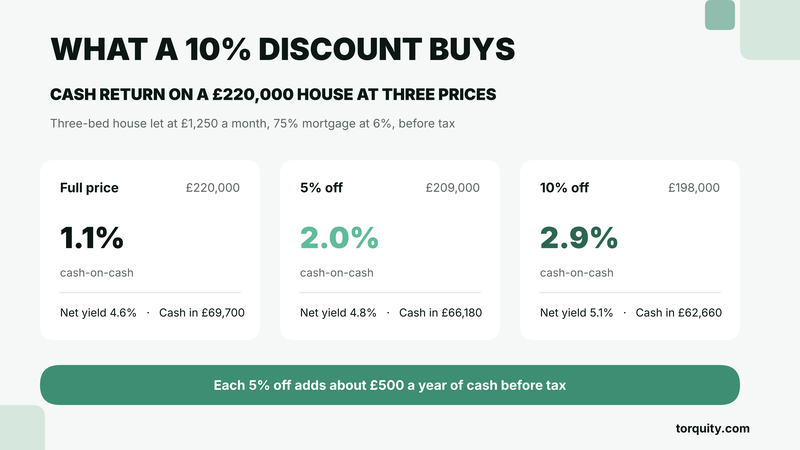
- Full price, £220,000: stamp duty £12,900, cash in £69,700, interest £9,900. Net yield 4.6%, cash-on-cash 1.1%.
- 5% off, £209,000: stamp duty £12,130, cash in £66,180, interest £9,405. Net yield 4.8%, cash-on-cash 2.0%.
- 10% off, £198,000: stamp duty £11,360, cash in £62,660, interest £8,910. Net yield 5.1%, cash-on-cash 2.9%.
Each 5% off adds about £500 a year of cash before tax. The discount also cuts stamp duty and the deposit. So the cash-on-cash return rises faster than the net yield.
The rent drives every line here. Check it for your target street in our free rent calculator before you make an offer.
Even at 10% off, the house returns 2.9% on cash before tax. The case rests on rent growth and the price you pay.
Where the discounts may run deepest
ONS data for September 2026 points to a split market. London prices fell 3.5% in a year, while London rents average £2,350 a month, the highest in England. The North East shows the opposite: prices up 4.6% and the lowest average rent, at £793.
A London flat bought from a selling landlord may come with the biggest discount. It will still carry the lowest gross yield. A northern terrace yields more, but rising prices leave sellers less reason to cut. Run both through the same three-price test before you choose a region.
Our London postcode figures for October show where asking prices sit. Some sellers will take a loss, and our guide to selling a buy-to-let at a loss covers the tax side.
Where the numbers break
Survey intentions do not equal sales. The Pegasus poll covered 168 landlords, and the Landbay survey shows far fewer planning to sell. Treat 52% as a mood reading.
Many sellers will offer the house with a tennant in place. That changes the price you should pay and the rent you can charge. Our guide to what discount makes a tenanted buy-to-let worth buying works through the numbers.
A stalled sale can help you. If the seller's tenant has gone, the seller cannot re-let for a year after using the sale ground. Our piece on selling with vacant possession explains the ban. A seller facing that gap may accept a lower offer.
Rates can rise again. The Bank meets on 17 December 2026. Each extra point on a £148,500 loan costs £1,485 a year. A 10% discount adds only £990 a year against full price.
Rent growth also varies by place. ONS puts the North West at 5.6% and the South West at 3.3%. Check your street before you count on the national figure.
Checklist before you make an offer
- Ask why the landlord is selling and how long the home has sat on the market.
- Find out whether the tenant stays and what rent they pay.
- Compare the asking price with sold prices on the same street.
- Run the deal at today's rate and one point higher.
- Price the EPC, gas and electrical certificates before you offer.
- Back any offer below the asking price with your own rent and cost figures.
Where Torquity fits
Torquity estimates rent from comparable lettings with a confidence range. It calculates net yield, DSCR and cash-on-cash at any price you enter. Run the asking price and your offer side by side to see what the discount buys. The rent calculator gives a fast check on the rent first.
General information, not tax or financial advice.
How we wrote this
Liza Herman, Research and Marketing at Torquity, wrote this article with AI assistance in drafting. Landlord surveys come from Pegasus Insight via Mortgage Solutions (10 November 2026) and Landbay via Landlord Today (5 November 2026). Purchase data comes from Paragon Bank via Mortgage Solutions (18 November 2026). Rent and price data comes from ONS (18 November 2026). Repossession data comes from UK Finance via Landlord Today (16 November 2026). Bank Rate comes from the Bank of England (5 November 2026). We checked all sources on 19 November 2026. The house, the rent, the rate and the costs are our own assumptions.