
 Lizaveta Herman
The short answer

A buy-to-let sold for less than it cost creates an allowable loss for Capital Gains Tax. The loss cuts tax on other gains in the same tax year or later ones. You must claim it within four years of the end of the tax year of the sale (GOV.UK). In our London example, a £53,160 loss cuts the tax on a second sale from £13,680 to £921.60.
How often landlords sell at a loss
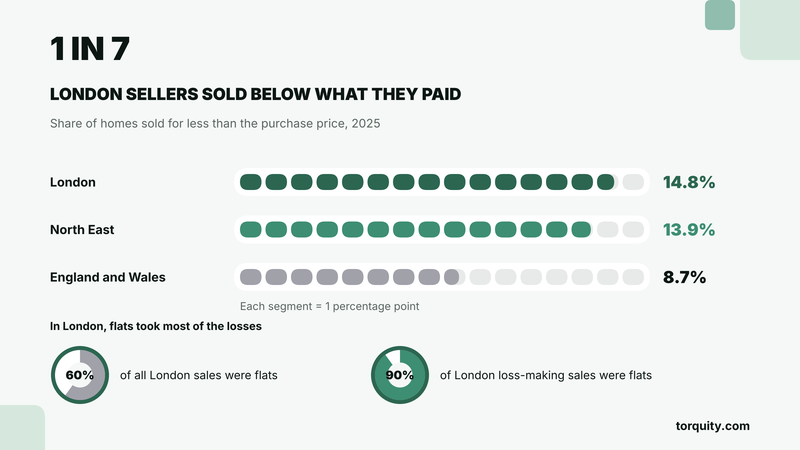
Hamptons found that 14.8% of London sellers sold for less than they paid in 2025. No region in England and Wales came higher. The North East followed at 13.9%, and the national figure stood at 8.7% (Landlord Today, January 2026). Flats made up 60% of London sales yet 90% of the London homes sold at a loss.
Those figures cover all sellers. Landlords sell in volume too. Pegasus Insight produced its Q2 2026 report with the lender Foundation. It found 22% of landlords sold a property in the previous 12 months. Only 6% bought one (Mortgage Professional, August 2026). Only 23% of landlords now feel confident about their letting business (The Intermediary, November 2026).
What the tax rules allow
- The loss equals the sale price minus your costs. Those cover the purchase price, buying and selling costs, and improvements (GOV.UK).
- Buying costs include stamp duty. HMRC's Capital Gains Manual lists it as an allowable incidental cost, with legal and agent fees.
- Decorating and other routine upkeep do not count.
- The loss comes off gains in the same tax year first, in full.
- Losses carried forward from earlier years only bring later gains down to the £3,000 allowance. The rest waits.
- A sale to a spouse, a relative or another connected person usually blocks the loss.
Rates for 2026 to 2027 sit at 18% within the basic rate band and 24% above it. The annual allowance is £3,000 (GOV.UK).
Worked example: a London flat bought in 2016
Tom, a hypothetical higher-rate taxpayer, bought a two-bed flat in London in 2016 for £400,000. Stamp duty and legal fees cost him £15,000. He sells in December 2026 for £370,000. The figures are our assumptions.
- Sale price: £370,000
- Estate agent at 1.5% plus VAT: £6,660
- Solicitor: £1,500
- Net proceeds: £361,840
- Purchase price plus buying costs: £415,000
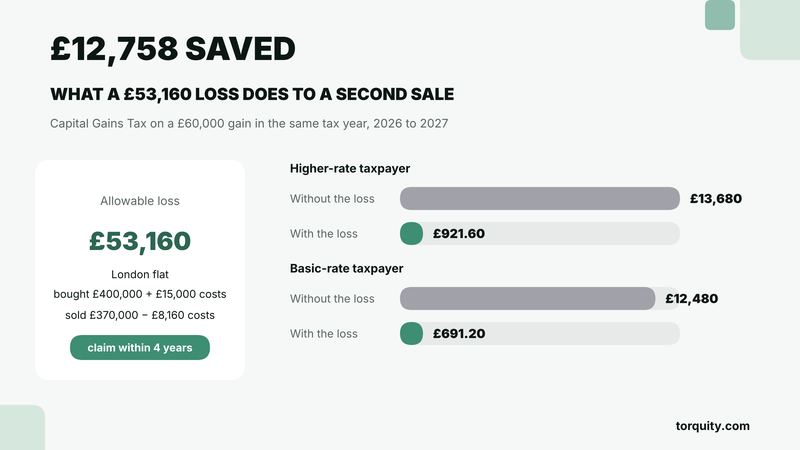
- Allowable loss: £53,160
In March 2027 Tom also sells a Manchester terrace with a £60,000 gain after costs. Both sales fall in the 2026 to 2027 tax year.
- Without the loss: £60,000 minus the £3,000 allowance leaves £57,000. At 24%, the tax comes to £13,680.
- With the loss: £60,000 minus £53,160 leaves £6,840. After the allowance, £3,840 is taxable. The tax comes to £921.60.
A basic-rate taxpayer saves almost as much. Say Tom had £20,000 of basic rate band left. Without the loss he would pay £3,600 at 18% and £8,880 at 24%, £12,480 in total. With it, he pays £691.20. The saving comes to £11,788.80.
The loss saves the higher-rate Tom £12,758.40. If the terrace sale slips into 2027 to 2028, he gets the same result. The carried-forward loss would bring the gain down towards the allowance and run out at £6,840.
Before you sell, check what the flat would let for. Our free rent calculator gives the rent to weigh against the tax saving.
Where the plan goes wrong
A fall in value gives you nothing to claim while you hold the flat. The loss arises on the sale, at completion values. Until then it stays a number on a valuation report.
A small gain in the loss year wastes part of the loss. Same-year losses come off in full, even below the allowance. Say Tom also sold shares that year at a £2,500 gain. The allowance would have covered it anyway. The loss wipes it out first, and £2,500 of loss buys Tom nothing.
A family sale usually kills the loss. Selling the flat cheaply to a sibling or a child counts as a connected-person disposal. Tom could then use the loss only against gains on other disposals to that same person.
The sale itself may stall. Hamptons found that 51% of homes landlords listed in 2025 did not sell. Among flats the figure reached 60% (Mortgage Solutions, July 2026). If Tom's tenant has already left, he may face a year in which he cannot re-let. Our piece on selling a rented home with vacant possession prices that wait.
Deadlines run on the gain side too. Tom must report and pay tax on the Manchester sale within 60 days of completion (GOV.UK). Late payment adds interest and a penatly.
Checklist before you sell at a loss
- Find the completion statement from the purchase, with stamp duty and legal fees.
- Keep invoices for improvements. Leave out decorating.
- Get two valuations and compare them with sold prices on your street.
- Time your other disposals. A small gain in the loss year wastes loss.
- Claim the loss within four years of the end of the tax year of the sale.
- Report and pay any taxable gain within 60 days of completion.
- Take advice before selling to family or out of a company.
Where Torquity fits
Before you sell, compare the sale with holding on. Torquity estimates rent from comparable lettings with a confidence range and calculates net yield, DSCR and cash-on-cash on today's value. If the net yield on £370,000 beats your alternatives, the loss can wait. Our Autumn Budget 2026 piece covers the tax side of holding.
If you do sell, our article on whether 2027 is a buyer's market shows who is buying.
General information, not tax or financial advice.
How we wrote this
Liza Herman, Research and Marketing at Torquity, wrote this article with AI assistance in drafting. Tax rules come from GOV.UK pages on CGT losses, rates, working out the gain and reporting within 60 days. We also used HMRC's Capital Gains Manual, CG15250. We checked all of them on 10 November 2026. Hamptons data comes via Landlord Today (January 2026) and Mortgage Solutions (July 2026). Pegasus Insight data comes via Mortgage Professional (August 2026) and The Intermediary (November 2026). Tom and his properties are hypothetical, and the costs rest on our own assumptions.