
 Lizaveta Herman

The short answer
The raw average dipped, and the adjusted index held flat. Nationwide’s October 2026 index puts the average UK price at £273,566, down £685 on September. After seasonal adjustment prices held flat on the month. They still sit 0.5% above October 2025.
September brought the real monthly fall, at 0.3%. For a landlord the trend matters more than either month. Annual growth slowed to 0.5%, the weakest since January 2024. On a typical buy-to-let that leaves rent to carry most of the return.
What Nationwide reported
- Monthly change, seasonally adjusted: -0.0% in October, after -0.3% in September
- Annual change: 0.5%, down from 0.8%
- Average price, not seasonally adjusted: £273,566, against £274,251 in September
Robert Gardner, Nationwide's chief economist, tied the slowdown to rates. Conflict in the Middle East has pushed energy prices up and fed inflation fears. Markets now expect Bank Rate rises and those expectations keep mortgage pricing high. Surveyors also report weak new buyer enquiries, and consumer sentiment dipped in October.
He sees support too. Incomes have outpaced house prices for two years. Household debt sits close to 20-year lows against disposable income. Employment and real incomes are holding up.
Nationwide publishes regional figures each quarter. In the third quarter of 2026 Northern Ireland led at 5.9% annual growth. East Anglia fell 0.7% (Nationwide HPI). A national 0.5% hides both ends.
Our own listing data breaks October asking rents and prices down by region. See London, the South, the Midlands and the North and Scotland and Wales.
Rents keep climbing while prices stall
The ONS October 2026 bulletin tells a different story for rent. UK private rents rose 3.8% in the 12 months to September 2026, to an average of £1,406 a month. England averaged £1,466. The North West led English regions at 5.7%, while London and the South East rose 3.5%.
ONS house prices, a separate index, rose 0.9% in the 12 months to August 2026. Both sources point the same way. Prices barely move while rents grow four times faster.
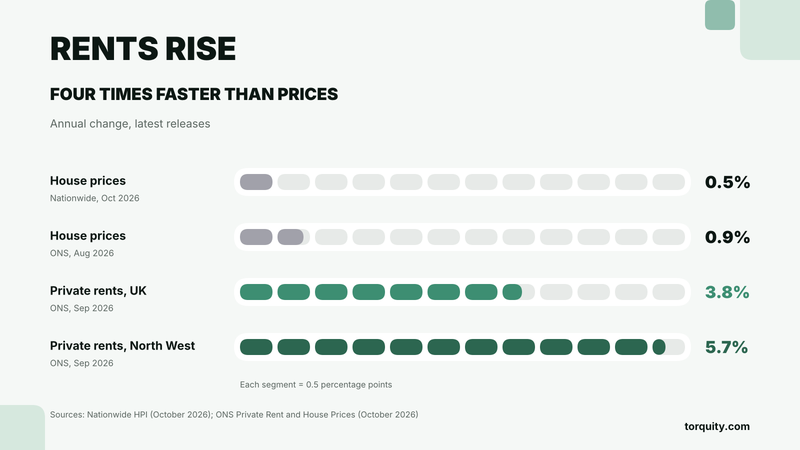
That gap lifts gross yields. Take our example below. A 3.8% rent rise and 0.5% price growth push its gross yield from 6.8% to 7.0% in a year. The rise adds £570 of rent and about £466 of net income after management and voids.
Worked example: a £220,000 buy-to-let
Take a two-bed house bought for £220,000 and let for £1,250 a month. The buyer takes a 75% interest-only mortgage of £165,000 at 5.5%. The rate is our assumption.
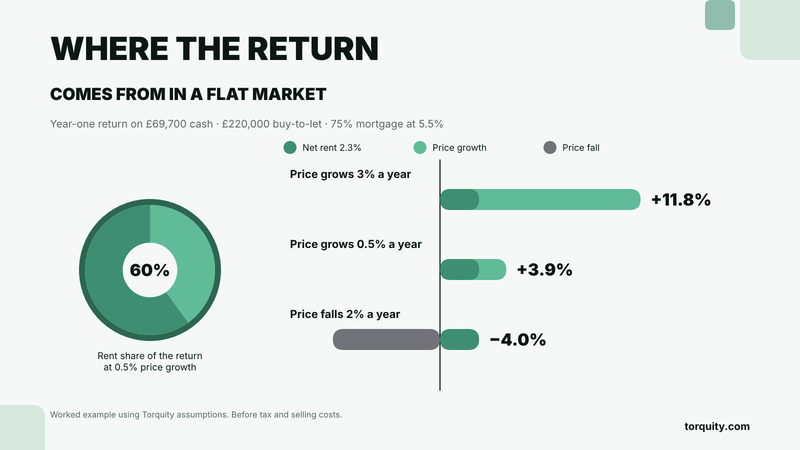
Stamp duty comes to £12,900 at the current residential rates with the 5% surcharge for additional homes. Legal costs add £1,800. Cash in: £69,700. Here is year one, from gross to net.
- Gross rent: £15,000
- Management at 12% plus VAT: £2,160
- Two weeks' void: £577
- Repairs, insurance and certificates: £1,500
- Landlord database fee: £65
- Mortgage interest: £9,075
- Net income before tax: £1,623
That gives 2.3% on the cash put in, before tax. Now add three growth paths for the house price.
- 0.5% a year, Nationwide's October pace: £1,100 of growth. Total return on cash: 3.9%.
- 3% a year, our upside case: £6,600 of growth. Total return on cash: 11.8%.
- A 2% fall: £4,400 lost. Total return on cash: minus 4.0%.
At 0.5% growth, net rent delivers 60% of the return. At 3%, it delivers a fifth. A buyer who priced in 3% a year now owns a rent deal with a thin margin.
The rent carries this deal. Check the rent on your target street in our free rent calculator before you price in growth.
The hold period widens the gap. Over five years at 0.5% a year, the £220,000 house gains about £5,555. At 3% a year, it gains about £35,040. A buyer who planned to refinance on growth after five years gets a sixth of the equity.
Growth also stays on paper until a sale. Selling costs and tax come off first, and the example ignores both.
Where the numbers break
Rates hit hardest. Each extra point on the mortgage costs £1,650 a year, which wipes out the £1,623 of net income. Nationwide's comment on Bank Rate expectations keeps that scenario on the table. Our article on what 6% mortgage rates do to a buy-to-let deal runs the full range.
Rent has its own ceiling. A rise you pencil in may not survive a tenant challenge. Our section 13 tribunal guide shows where challenges tend to land.
Regional spread adds risk in both directions. A buyer in East Anglia faced falling prices through the third quarter, while Northern Ireland gained nearly 6%. Price your own street. The national index can only point the direction.
Rent growth can stall as well. ONS puts annual rent growth in Scotland at just 0.7% to September 2026, against 4.0% in England. A deal that relies on rent to fill the growth gap needs a local rent check.
Monthly numbers also wobble. September's 0.3% fall turned flat in October. Read three months together before you change a valuaton.
Checklist before you buy in a flat market
- Model three growth cases, including a fall of 2% or more.
- Judge the deal on net rent after finance, before any growth.
- Stress the mortgage at one point above your quoted rate.
- Check the rent against achieved rents on comparable lettings.
- Compare the asking price with sold prices on the same street.
- Read Nationwide's regional figures for your area, and its next monthly release.
Where Torquity fits
Torquity estimates rent from comparable lettings with a confidence range, then works through to net yield, DSCR and cash-on-cash. Run a deal with zero growth and you see whether rent alone covers the mortgage. The rent calculator gives a quick first check on the rent.
General information, not tax or financial advice.
How we wrote this
Liza Herman, Research and Marketing at Torquity, wrote this article with AI assistance in drafting. Figures and comments come from Nationwide, Annual house price growth slows again in October (30 October 2026). Regional figures come from Nationwide's HPI data for the third quarter of 2026. Rent figures come from ONS, Private rent and house prices, UK: October 2026. Stamp duty rates come from GOV.UK, checked on 10 November 2026. The £220,000 house, its rent, the mortgage rate and the growth paths are our own assumptions, not a forecast.