
 Lizaveta Herman

The short answer
Sign up if you let property in England or Wales. HM Land Registry lists rented, empty and mortgage-free homes among those more at risk of fraud. Property Alert costs nothing and covers up to 10 properties. A restriction on the title costs nothing too, if you own privately and live elsewhere. Both take an afternoon.
How title fraud reaches landlords
In title fraud, someone poses as the owner and sells, or mortgages the home. The register changes and the owner finds out late. A landlord who lives miles away sees no post at the property. The tenant has no reason to question a stranger's paperwork.
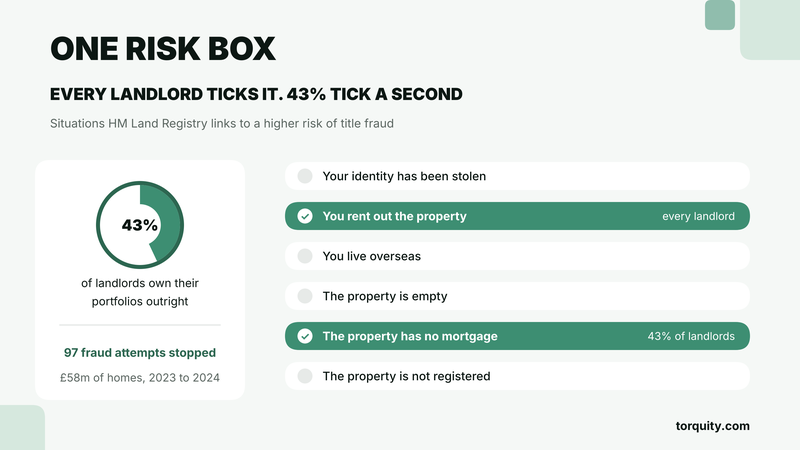
HM Land Registry stopped 97 registered title fraud attempts between April 2023 and March 2024. The homes involved were worth £58 million in total (GOV.UK, Property Alert).
GOV.UK names six situations that raise the risk:
- your identity has been stolen
- you rent out the property
- you live overseas
- the property is empty
- the property has no mortgage
- the property is not registered with HM Land Registry
Many landlords tick two boxes at once. Pegasus Insight puts the share of landlords who own their portfolios outright at 43% (The Intermediary, November 2026).
The three tools
- Property Alert. Free email alerts for up to 10 properties. An alert fires when someone applies to change the register, such as a new mortgage. Each alert shows the type of activity, the applicant and the time it arrived. The alert warns you and leaves the change in place.
- A restriction. HM Land Registry will not register a sale or mortgage unless a conveyancer certifies that the owner applied. Private owners who live elsewhere use form RQ, free. Companies use form RQ(Co), also free. Owners who live at the property use form RX1, at £40.
- The title register. The Search property information service sells the title register for £7 and the title plan for £7. The property summary is free.
Form RQ has one trap. HM Land Registry will not normally enter the restriction if the only contact address given is the property itself. Give your home address as well. Private owners post the form to HM Land Registry Citizen Centre, PO Box 7806, Bilston, WV1 9QR.
Worked example: three flats, no mortgage
Take Daniel, a hypothetical landlord who owns three flats outright in Leeds, Sheffield and Bradford. Each is worth about £180,000, so £540,000 sits on the register with no lender's charge on any title. He lets each flat for £850 a month, £30,600 a year in gross rent (our assumptions).
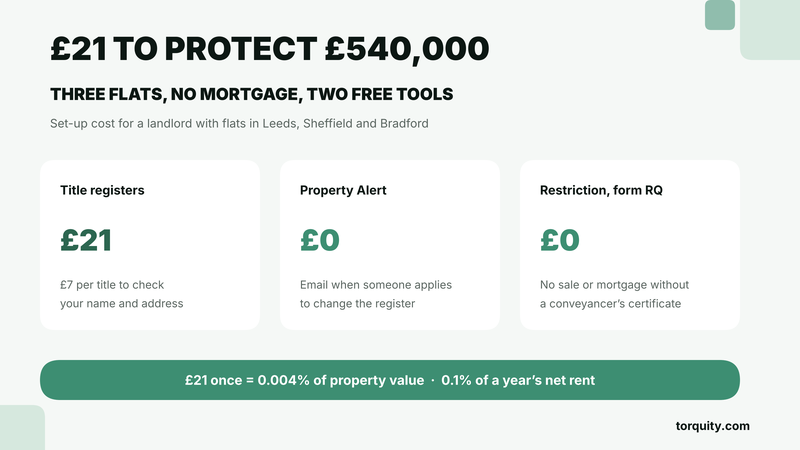
- Download the three title registers to check his name and contact address: £21
- Sign up the three titles to Property Alert: £0
- Lodge form RQ on each title: £0
- Total set-up cost: £21
Daniel spends £21 to watch £540,000 of property, or 0.004% of its value. Against his gross rent the cost comes to 0.07%. After 12% management plus VAT and £1,500 of running costs per flat, his net income before tax is £21,694. The set-up takes 0.1% of that, once.
Daniel's £21,694 rests on the rent each flat earns. Check the rent on your own flats in our free rent calculator.
The restriction adds a cost later. When Daniel sells or remortgages, his conveyancer must certify his identity. GOV.UK warns that a conveyancer may charge for that certificate. Ask for the fee in the quote before you instruct.
What to do when an alert arrives
Read the alert first. It names the type of application and the applicant. If you or your conveyancer filed it, you need do nothing.
If nobody you know filed it, call the property fraud line on 0300 006 7030. It runs Monday to Friday, 8am to 4.30pm, and you can also email reportafraud@landregistry.gov.uk. Have the title number and the alert to hand.
Property Alert also covers homes you do not own. You can watch a parent's house or a relative's flat, as long as the total stays within 10.
Where protection falls short
Alerts go to the email address on your account. Change jobs or providers without updating it, and the warning lands nowhere. The same goes for the contact address on the register: HM Land Registry writes there, so keep it current.
Alerts arrive after an application lands. You must judge each one and act fast. Your own remortgage triggers an alert too, so not every email signals fraud.
Unregistered land sits outside both tools. Register it first. Homes in Scotland and Northern Ireland use separate registers, so this guide covers England and Wales only.
A restriction slows legitimate deals by a step. Expect your conveyancer to ask for extra identity documents, and allow a few days for the certifcate.
Checklist for landlords
- Download each title register and check the owner's name and contact addresses.
- Tell HM Land Registry about any out-of-date address.
- Sign up each title to Property Alert, up to 10 per account.
- Lodge form RQ, RQ(Co) or RX1, whichever fits how you own the home.
- Save the property fraud line number in your phone.
- Check each register once a year, on the same day you renew the gas safety certificate.
- Add each new purchase to Property Alert on completion. Our guide to buying a tenanted buy-to-let covers the rest of the completion checklist.
Where Torquity fits
Torquity works on the deal before you buy. It estimates rent from comparable lettings with a confidence range and calculates net yield, DSCR and cash-on-cash. Title protection starts after completion, as one more line on the compliance list in our Renters’ Rights Act guide. Check the rent first in the rent calculator.
Registration on the new landlord database comes next. Our Register your rental property guide lists the deadlines by region.
General information, not legal or financial advice.
How we wrote this
Liza Herman, Research and Marketing at Torquity, wrote this article with AI assistance in drafting. Service details, fees, forms and fraud figures come from three GOV.UK pages, checked on 10 November 2026. They cover Property Alert, protecting land and property from fraud, and searching land and property information. The share of landlords who own outright comes from Pegasus Insight as reported by The Intermediary (3 November 2026). Daniel, his flats and his rents are hypothetical, and the running costs are our own assumptions.