
 Lizaveta Herman

The short answer
Every landlord in England who lets a home on an assured or regulated tenancy must join the new database. The government's Register your rental property service opens on 15 December 2026 in the West Midlands. London follows in July 2027. The South West closes the rollout on 14 November 2027.
The fee is £65 a property a year. Until 15 November 2027 the service charges nothing for the days, so early registration costs a few pounds. A missed deadline risks a council penalty of up to £7,000 and blocks most possession claims.
What the rules ask of you
The duty comes from the Renters’ Rights Act 2025 and the database regulations made under it. GOV.UK guidance for landlords sets out who registers and what they supply.
- Each landlord registers once, then adds every let property. Joint landlords each hold their own entry.
- Sign-in runs through GOV.UK One Login. You also need a correspondence address in England or Wales.
- Each property record asks for the bedrooms, the rent, the tenancy details and any licence, such as an HMO licence.
- You supply evidence of the gas safety certificate, the electrical safety certificate and the EPC.
- Optional details can follow within 28 days. Miss that window and the service may deactivate the property.
A letting agent cannot start the process for you. Once the property has a registration number the agent can add tenancy and safety details. The record stays your legal responsibility.
The regional timetable
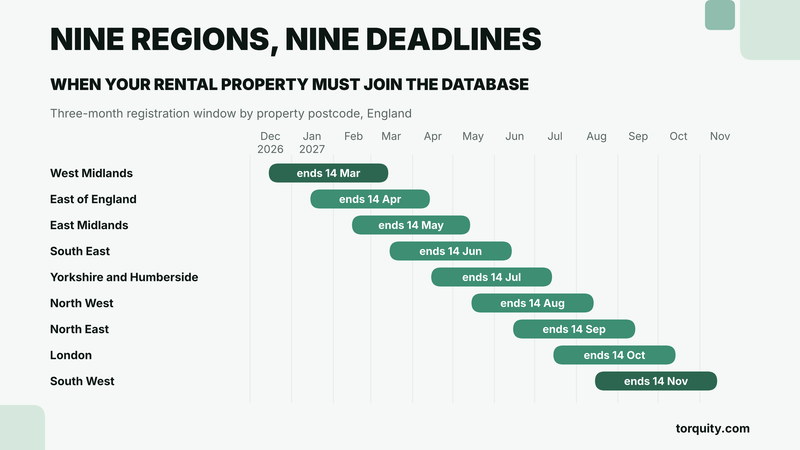
Each region gets a three-month window. The property's postcode decides the window. Your home address plays no part.
- West Midlands: 15 December 2026 to 14 March 2027
- East of England: 15 January to 14 April 2027
- East Midlands: 15 February to 14 May 2027
- South East: 15 March to 14 June 2027
- Yorkshire and Humberside: 15 April to 14 July 2027
- North West: 15 May to 14 August 2027
- North East: 15 June to 14 September 2027
- London: 15 July to 14 October 2027
- South West: 15 August to 14 November 2027
You may register before your region opens. You cannot register late once its window has closed.
Worked example: three homes, three deadlines
Take Priya, a hypothetical landlord with three let homes: a flat in Birmingham, a terrace in Leeds and a flat in Lewisham. Her deadlines fall on 14 March, 14 July and 14 October 2027.
The GOV.UK formula charges the £65 annual fee only for days after 15 November 2027 within the first paid year. So the later you register, the bigger your first bill. Priya has two routes.
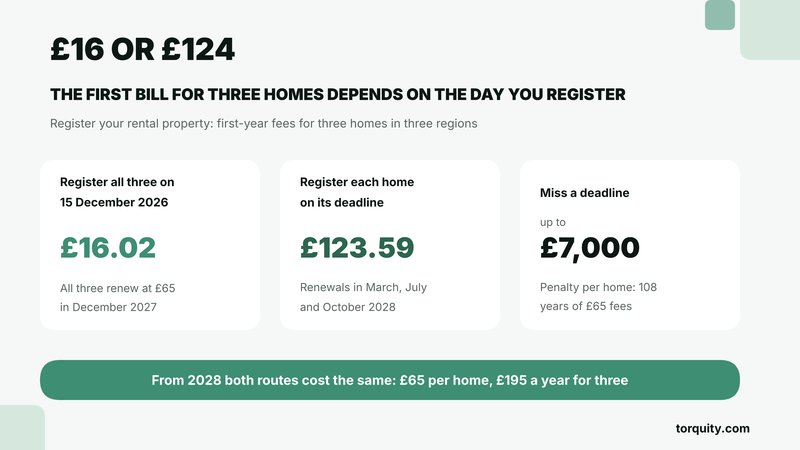
- Register all three on 15 December 2026: £5.34 each, £16.02 in total. All three renew at £65 in December 2027.
- Register each home on its deadline: £21.31 for Birmingham, £42.97 for Leeds and £59.31 for Lewisham. That comes to £123.59, with renewals in March, July and October 2028.
Both routes cost the same for every day after 15 November 2027. Early registration moves the renewal date forward and saves nothing over time. From 2028 Priya pays £195 a year for three homes.
Now run it through her rent. We assume the three homes let for £3,600 a month together.
- Gross rent: £43,200 a year
- Management at 12% plus VAT: £6,221
- Two weeks' void per home: £1,662
- Repairs, insurance and certificates at £1,500 per home: £4,500
- Database fees: £195
- Net income before finance and tax: £30,622
The fee takes 0.45% of gross rent and 0.64% of net income. A management fee falls when rent falls. The database fee stays flat, so it bites harder on cheap stock.
Where it goes wrong
The fee rarely hurts. A missed step does. GOV.UK lists penalties of up to £7,000 for failing to register. False information or repeated breaches can cost up to £40,000. On one home, £7,000 equals 108 years of fees.
The government’s guide to the Act also fines landlords who let or advertise a property before registering it. Adverts must carry the registration numbers. Register before you market a vacant home, even ahead of your region's window.
Possession carries the biggest risk. A landlord in breach of the duty cannot get a possession order. Two grounds escape the ban: 7A and 14, both for anti-social behaviour. A seller relying on ground 1A with a lapsed record stalls at court. Our piece on selling a rented home with vacant possession shows what each month of delay costs.
Tenants gain a remedy too. From 15 December 2026 they can seek a rent repayment order in some cases. Their area's window must have opened first.
Checklist before your window opens
- Set up a GOV.UK One Login for each landlord named on the title.
- Match every property to its region by postcode and diary each deadline.
- Collect the current gas safety record, EICR and EPC for each home. Our EPC C cost guide covers what a rating below C will cost by 2030.
- Check that each tenancy's rent and start date match your paperwork.
- Diary the 28-day deadline for the optional detials.
- Add the registration numbers to every advert template.
- Budget £65 a property a year from 2028.
The database sits alongside the rest of the compliance list in our Renters’ Rights Act guide. It adds one login and one annual payment per home.
Where Torquity fits
Torquity estimates rent from comparable lettings with a confidence range, then works through to net yield, DSCR and cash-on-cash. Add the £65 fee to running costs and you see what each home keeps. The rent calculator shows whether the rent you record sits near the market.
General information, not legal, tax or financial advice.
How we wrote this
Liza Herman, Research and Marketing at Torquity, wrote this article with AI assistance in drafting. Rules, fees and the regional timetable come from GOV.UK, Register your rental property service: guidance for landlords. We checked it on 10 November 2026. Penalties and possession rules come from the GOV.UK Guide to the Renters' Rights Act. We also used the Renters' Rights Act 2025 on legislation.gov.uk. Priya, her homes and her rents are hypothetical, and the costs rest on our own assumptions.